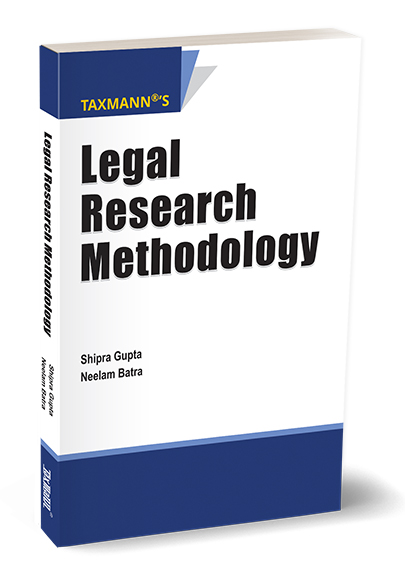
Taxmann Legal Research Methodology By Shipra Gupta , Neelam Batra Edition 2025
Taxmann Legal Research Methodology By Shipra Gupta , Neelam Batra Edition 2025
Legal Research Methodology is a comprehensive and classroom-tested textbook that combines doctrinal, socio-legal, and empirical approaches to legal inquiry. It guides readers from the fundamentals—sources of law and legal reasoning—to advanced research skills, including literature review, problem formulation, research design, sampling, and data analysis. The book also addresses critical themes of research ethics, plagiarism, copyright, and predatory publishing, making it especially relevant in today’s academic environment. Authored by Prof. (Dr) Shipra Gupta and Dr Neelam Batra, it is an essential resource for students, faculty, researchers, and practitioners seeking structured, ethical, and practice-oriented legal research.

Description
Taxmann Legal Research Methodology By Shipra Gupta ,Neelam Batra Edition 2025
Legal Research Methodology is a comprehensive and classroom-tested textbook that combines doctrinal, socio-legal, and empirical approaches to legal inquiry. It guides readers from the fundamentals—sources of law and legal reasoning—to advanced research skills, including literature review, problem formulation, research design, sampling, and data analysis. The book also addresses critical themes of research ethics, plagiarism, copyright, and predatory publishing, making it especially relevant in today’s academic environment. Authored by Prof. (Dr) Shipra Gupta and Dr Neelam Batra, it is an essential resource for students, faculty, researchers, and practitioners seeking structured, ethical, and practice-oriented legal research.
Book Description
Legal Research Methodology is a modern, classroom-tested textbook that blends doctrinal (‘black-letter’) methods with socio-legal and empirical approaches, enabling readers to locate the law, analyse it rigorously, and examine how it operates in society. The book progresses from foundational concepts (sources of law, legal reasoning) to hands-on research skills (literature reviews, problem formulation, research design, sampling, data collection/analysis). It concludes with research ethics, copyright & plagiarism, as well as predatory journals—a rare, much-needed focus for law students and scholars today.
This book is intended for the following audience:
- LL.B./B.A.LL.B. & LL.M. Students learning research methodology, project writing, or dissertations
- Faculty & Researchers seeking a structured, step-by-step approach (with chapter-end Summaries to reinforce learning)
- Practitioners, Policy Researchers & Judges’ Law Clerks who need fast, precise strategies for finding, evaluating, and applying authorities; and for undertaking socio-legal/empirical studies
- Interdisciplinary Scholars engaging law with sociology, economics, public policy, or technology
The Present Publication is the Latest Edition, authored by Prof. (Dr) Shipra Gupta & Dr Neelam Batra, with the following noteworthy features:
- [Complete Methodological Coverage] The text explains methodology as a framework linking paradigm, research design, and approach, and contrasts doctrinal with non-doctrinal (socio-legal) methods
- [Practical & End-to-end] Guidance spans problem identification, questions/hypotheses, design, sampling, data collection, analysis, and report writing, with chapter-end summaries that reinforce learning
- [Legal Reasoning] A dedicated chapter covers inductive and deductive reasoning, fallacies, and legal syllogisms
- [Tools for Modern Research] Curated open and commercial e-resources (e.g., India Code, PRS, Indian Kanoon, etc.) are catalogued to aid authoritative, up-to-date work
- [Ethics & Integrity] A whole chapter addresses research ethics, plagiarism vs. copyright infringement, predatory publishing, and journal-selection checklists
- [Endorsed by Justice Augustine George Masih | Supreme Court of India] He highlights the book’s role in bridging academic rigour with practical application in courts and policy-making
The coverage of the book is as follows:
- Chapter 1 – Introduction to Legal Research
- Explains the meaning, scope and significance of legal research for practitioners and academics
- Outlines the role of legal research in law reform (Law Commission reports, Constituent Assembly debates, committees and judicial legislation)
- Distinguishes primary and secondary authorities and surveys electronic/online resources
- Chapter 2 – Legal Research Methodology
- Defines ‘method’ and ‘methodology,’ and sets out the components of methodology—paradigm, research design and approach
- Maps the broad categories of legal research methodologies
- Chapter 3 – Socio-Legal Research (SLR)
- Presents SLR as an interdisciplinary inquiry with theoretical and empirical dimensions and notes typical field challenges
- Chapter 4 – Methods of Reasoning
- Covers argument construction, fallacies, inductive and deductive reasoning, and the contours of legal reasoning
- Chapter 5 – Review of Literature
- Details sources and tools for judicial/legislative and secondary materials, evaluation standards and organisation strategies for literature reviews
- Chapter 6 – Identification & Formulation of Problem:
- Provides staged guidance on framing titles and formulating researchable problems
- Chapters 7/8 – Variables; Research Questions & Hypotheses
- Explains variable types and operationalisation, and sets criteria and typologies for questions and hypotheses
- Chapter 9 – Research Design
- Reviews exploratory, descriptive, explanatory, experimental and correlational designs, and explains time-dimension choices (cross-sectional vs. longitudinal)
- Chapter 10 – Sampling
- Sets fundamental rules for sampling and distinguishes probability from non-probability techniques with methods and examples
- Chapter 11 – Data Collection Techniques & Tools
- Covers questionnaires, interviews and observation, including practical and ethical considerations for fieldwork
- Chapter 12 – Research Ethics & Academic Integrity
- Summarises ethical principles, plagiarism vs. copyright infringement, and red flags for predatory journals with regulatory context (e.g., UGC norms)
- Chapter 13 – Data Analysis & Report Writing
- Brings qualitative and quantitative analysis together with guidance on structuring and presenting a legal research report
The structure of the book is as follows:
- Chapters progress in a logical sequence from foundations (concept, sources and tools) to methodology and design, then to sampling, data-collection methods, ethics and reporting
- Each chapter closes with a succinct ‘Summary,’ enabling quick revision and classroom use
Additional information
| Weight | 0.8 kg |
|---|---|
| Authors | |
| Binding | |
| Edition | |
| ISBN | |
| Language |