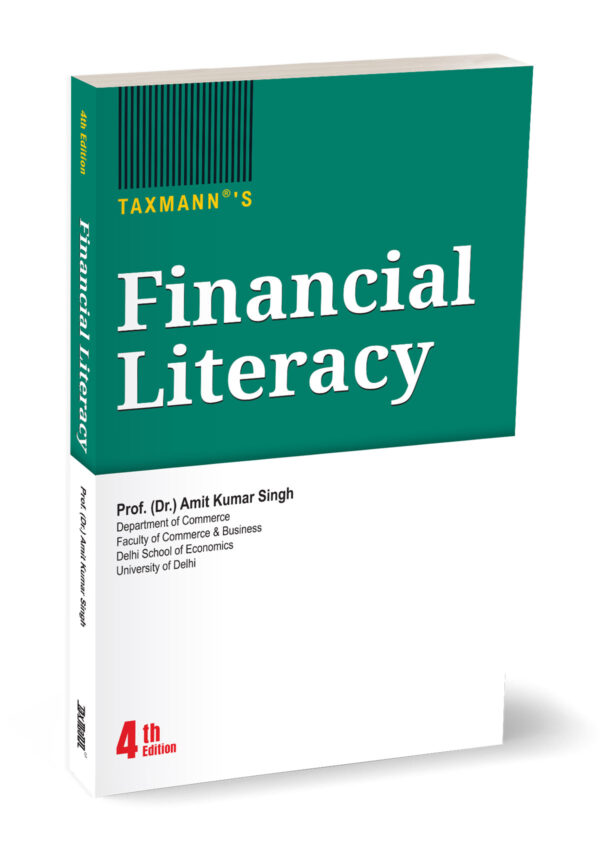
TAXMANN Financial Literacy By Amit Kumar Singh 4th Edition 2026
TAXMANN Financial Literacy By Amit Kumar Singh 4th Edition 2026
Financial Literacy is a comprehensive, NEP-aligned textbook that equips students with crucial skills for sound financial decisions. Authored by Prof. (Dr) Amit Kumar Singh, it covers financial planning, investment, taxation, and fraud protection through clear explanations, solved examples, and practical exercises. Spanning fifteen chapters across four key units, the book offers a progressive approach—from foundational concepts to advanced decision-making. With its blend of academic rigour and practical relevance, it’s helpful for undergraduates, early professionals, educators, and anyone looking to master personal finance.
Amit Kumar Singh
Prof. (Dr) Amit Kumar Singh is a Professor in the Department of Commerce, Faculty of Commerce and Business, Delhi School of Economics, University of Delhi. An alumnus of Kirori Mal College and the Department of Commerce, Delhi School of Economics, he is also a gold medallist in the M.Com. examination of the University of Delhi. A recipient of multiple medals and prizes at the postgraduate level, he completed his M.Phil. and Ph.D. in Commerce from the Delhi School of Economics.
With over two decades of teaching experience, Prof. Singh specialises in Finance, Investment Management, and Initial Public Offerings. He has authored or co-authored eight books and published over 100 research papers in ABDC, Scopus, and Web of Science-indexed journals. In addition to presenting widely at national and international conferences, he served for nearly twelve years at Shaheed Bhagat Singh College, University of Delhi. He was recently honoured with the Distinguished Alumni Award by Kirori Mal College.
Prof. Singh holds several important academic and administrative positions. He is Joint Director of the Delhi School of Public Policy and Governance (DSPPG), Institute of Eminence, University of Delhi; a former Chairman of the Governing Body of Gargi College, University of Delhi; and a former Treasurer of Maharishi Valmiki College of Education, University of Delhi. He is currently a member of the Governing Body of Miranda House, a Nodal Officer for the Youth for Nation Forum, a member of the Financial Literacy Committee, and a member of the Internal Complaint Committee at the University of Delhi. He is also a life member of the Indian Accounting Association and the Indian Commerce Association.
Since 2019, Prof. Singh has coordinated the Commerce DSC interface, organising over 100 workshops and guideline meetings for B.Com. (Hons.) and B.Com. (Prog.) courses. He also serves on the Financial Inclusion Committee at the University of Delhi and was recently elected Vice President of the Delhi Chapter of the Indian Commerce Association.

Description
TAXMANN Financial Literacy By Amit Kumar Singh 4th Edition 2026
Financial Literacy is a comprehensive textbook designed to equip undergraduate students with the fundamental concepts and skills to make informed financial decisions. It aligns with the National Education Policy (NEP) framework, ensuring readers gain theoretical knowledge and practical exposure to financial scenarios. The book addresses various facets of financial literacy—including financial planning, investment planning, tax planning, protection against financial frauds, banking products and services, etc. It emphasises the crucial role financial knowledge plays in an individual’s life, whether it’s budgeting, securing loans, investing wisely, or understanding taxation in India.
This book is intended for the following audience:
- Undergraduate Students – Primarily tailored for value-added courses under NEP in institutions like the University of Delhi but relevant to undergraduates across all disciplines
- Early Professionals & Young Adults – Anyone stepping into their professional journey and needing to handle savings, credit, or investments
- Educators & Trainers – Instructors implementing the NEP or teaching financial literacy will find it a valuable, structured resource
- General Readers – Individuals keen to gain clarity on personal finance, tax planning, and safe banking practices
The Present Publication is the 3rd Edition, authored by Prof. (Dr) Amit Kumar Singh, with the following noteworthy features:
- [Learning Outcomes at the Start of Each Chapter] Each chapter begins by outlining the specific skills and insights students are expected to gain. This approach gives readers a roadmap for focused learning
- [Simple—Lucid Text] Complex financial concepts are broken down into easy-to-understand language, helping readers from diverse academic backgrounds grasp the material
- [Solved Numerical Problems] Examples and solved illustrations demonstrate the practical application of financial theories, boosting conceptual clarity
- [Review Questions] Concluding each chapter, these targeted questions allow readers to self-assess their grasp of the concepts covered
- [Practical Exercises] Hypothetical yet realistic scenarios encourage hands-on application, helping readers build confidence in managing their finances
- [Case Studies & Examples] The content is supplemented with relatable examples, ensuring students can connect theory with practices
- [Supportive Annexures & Question Papers] The book also includes past question papers and references for quick revision and exam preparation
- [Academic & Professional Insight] The author’s extensive teaching and research background in finance lends both academic rigour and industry perspective to the text
- [Emphasis on Financial Security] The text repeatedly underscores the significance of financial discipline and security—protecting oneself against fraud, planning for contingencies, and building a stable financial future
The book spans fifteen chapters, organised into four central units, each addressing a crucial aspect of financial literacy:
- Unit I | Financial Planning and Financial Products
- Introduction to Financial Literacy – Explains key terminologies (like assets, credit, interest, Rule of 72) and the importance of being financially literate
- Saving & Spending Management – Covers the distinction between needs and wants, effective budgeting, and maintaining financial discipline
- Financial Goals & Planning – Discusses setting SMART financial objectives (Specific, Measurable, Achievable, Relevant, Time-bound) and the benefits of holistic planning
- Time Value of Money – Explains core concepts of compounding and discounting, showing how money’s value changes over time
- Unit II | Banking and Digital Payment
- Banking Products & Services – Outlines various deposit and loan products, retail banking vs. corporate banking, and day-to-day banking essentials
- Digitisation of Financial Transactions – Explores the impact of digital payment initiatives (credit/debit cards, net banking, UPI, digital wallets) and the technology’s implications
- Protection against Banking & Financial Frauds – Educates readers about Ponzi schemes, phishing, and other scams, along with practical tips to stay secure in the digital age
- Unit III | Investment Planning & Management
- Investment Concepts & Alternatives – Clarifies differences between investment and speculation, the idea of risk-return trade-offs, and strategies for building investment portfolios
- Mutual Funds – Dives into types of mutual fund schemes, cost structures, NAV calculations, SIPs, and tax implications
- Life & General Insurance (including Health Insurance) – Explains the importance of insurance for financial security, types of policies, claim processes, and government-sponsored health schemes
- Unit IV | Tax Planning
- Personal Tax Planning & Management – Differentiates between tax planning, tax avoidance, and tax evasion
- Taxation in India – Offers insight into India’s tax structure, both direct (Income Tax) and indirect (GST), and discusses old vs new income-tax regimes
- Deductions, Exemptions & E-Filing – Details the various provisions (Sections 80C to 80U), allowances, and the process of filing Income-tax returns electronically
- Each unit is designed to build upon the previous one, ensuring a progressive learning experience that starts with foundational knowledge and culminates in advanced financial decision-making techniques
The structure of the book is as follows:
- Four Thematic Units – The textbook is neatly broken down into four key units—Financial Planning, Banking & Digital Payments, Investment Planning, and Taxation—each focusing on specific competencies in financial literacy
- Chapter Flow
- Introductory Concepts and Learning Outcomes
- Body with Clear Headings/Subheadings
- Illustrations & Solved Examples
- Review Questions
- Practical Exercises
- Practical/Hands-on Approach – Each unit includes projects or activities (like surveys, mock investments, and e-filing practice) that bridge theory with practical financial tasks
Additional information
| Weight | 0.3 kg |
|---|---|
| Authors | |
| Binding | |
| Edition | |
| ISBN | |
| Language | |
| Publisher |