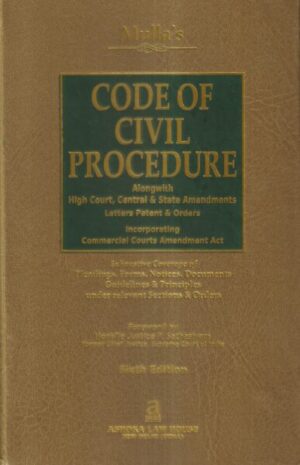
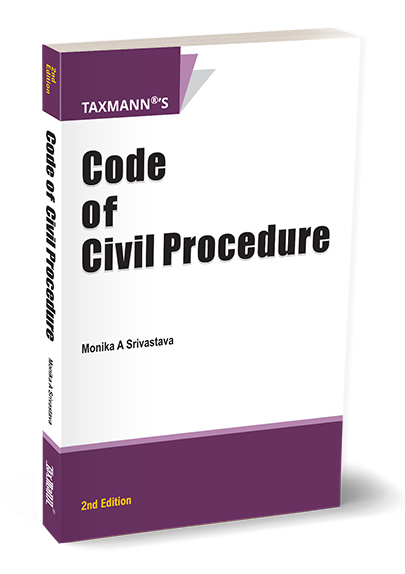
“Taxman Code of Civil Procedure By Monika A Srivastava Edition 2025 “
Taxman Code of Civil Procedure By Monika A Srivastava Edition 2025

Description
Taxman Code of Civil Procedure By Monika A Srivastava Edition 2025
The Code of Civil Procedure offers a rigorous, student-oriented journey through the entire civil action lifecycle—institution and pleadings, interlocutory stages, trial, decree, and execution—grounded in updated Supreme Court and leading High Court rulings. Designed for LL.B./LL.M. students, Judicial Services/AIBE aspirants, early-career civil litigators, and faculty, it blends precise exposition with courtroom relevance. The key features include a chronological ‘suit-to-execution’ architecture, doctrinal clarity with a practical focus, and interfaces with the Limitation Act, Evidence Act, Commercial Courts Act, and Section 89 of the CPC (mediation). Pedagogy emphasises illustrations, flowcharts, checklists, ‘common pitfalls,’ specimen-pleading cues, viva prompts, and quick-revise tables—plus curated student queries and hypotheticals that map rules to outcomes.
Book Description
Code of Civil Procedure presents a rigorous, student-oriented exposition that maps the complete lifecycle of a civil action—from institution and pleadings, through interlocutory stages and trial, to decree and execution—supplemented with updated Supreme Court and leading High Court rulings. Written in precise, instructive prose and enriched with illustrations, worked examples, and answers to recurring student queries, the book reflects the author’s combined vantage as teacher, practitioner, and former President of the District Consumer Commission, ensuring conceptual clarity with direct procedural applicability.
This book is intended for the following audience:
- LL.B. (3-year & 5-year) and LL.M. Students taking the CPC/procedure paper
- Judicial Services, AIBE & Other Competitive Exam Aspirants seeking concept-first coverage with recent case law
- Early-career Civil Litigators, Chamber Juniors, and Interns in civil, consumer or commercial courts
- Faculty requiring a classroom-tested text with clear sequencing and pedagogical aids
The Present Publication is the 2nd Edition, authored by Monika A Srivastava, with the following noteworthy features:
- [Chronological ‘Suit-to-Execution” Design] Builds procedural intuition stage by stage (plaint → written statement/set-off/counter-claim → issues → discovery → interim measures → trial → judgment/decree → execution)
- [Doctrinal Clarity with Practice Focus] Jurisdictional foundations, forum strategy, and interaction with Limitation Act, Evidence Act, Commercial Courts Act, and mediation under s. 89 CPC
- [Updated Case Law Integration] Concise takeaways at topic level; highlights on substantial question of law (s. 100), revision (s. 115), review (s. 114), and execution objections (s. 47)
- [Student-friendly Apparatus] Diagrams, flowcharts, checklists, and ‘common pitfalls’ boxes (e.g., res sub judice vs res judicata; review vs revision; plaint rejection under O. VII r. 11)
- [Drafting & Examination Support] Specimen pleadings cues, viva prompts, and end-chapter quick-revise tables
- [Learning Philosophy]
- Concept-first Sequencing – Emphasises conceptual ordering before memorisation to build procedural intuition
- Dual-purpose Utility – Equally effective as a teaching text and a chambers companion
- [Pedagogy & Practice]
- Student Queries Addressed – Curates recurring doubts at key junctures to clarify difficult procedural points
- Illustrative Hypotheticals – Bridges statute, case law, and courtroom practice to show rule-to-outcome mapping
- [Analytical Framework]
- Clear Demarcation – Separates doctrinal rules, discretionary standards, and procedural time-limits for precise application
- Allied-statute Cross-references – Integrates the Limitation Act, Evidence Act, Specific Relief Act, and Commercial Courts Act
The coverage of the book is as follows:
- Foundations & Jurisdiction
- Scheme of CPC; subject-matter, pecuniary and territorial jurisdiction (ss. 9–20); place of suing; transfer and stay; inherent powers (s. 151)
- Institution & Pleadings
- Plaint essentials, valuation and court-fees, return/rejection (O. VII r. 10/r. 11); written statement timeline & denials (O. VIII), set-off and counter-claim; amendment of pleadings (O. VI r. 17)
- Service & Non-appearance
- Issue and service of summons (O. V), substituted service; ex parte proceedings and remedies
- Framing of Issues & Discovery
- Issues (O. XIV); interrogatories, discovery, inspection (O. XI); admissions (O. XII); production and affidavit evidence; commissions (O. XXVI)
- Interim Measures
- Temporary injunctions and receivers (O. XXXIX, O. XL); arrest and attachment before judgment (O. XXXVIII); security for costs; case-management under commercial regime
- Trial → Judgment → Decree
- Conduct of trial; burden and standard of proof; examination of witnesses; judgment reasons (O. XX), decree-drawing and correction
- Execution of Decrees
- Competent court; transferee court; modes of execution (O. XXI: attachment, sale, arrest, delivery); claims/objections; resistance and restitution; satisfaction and stay
- Appeals, Review & Revision
- First and second appeals (ss. 96, 100), appealable orders (s. 104 & O. XLIII), review (s. 114 & O. XLVII), revision (s. 115); substantial question of law analysis; limitation checkpoints
- Special Suits & Parties
- Representative suits (O. I r. 8), indigent persons (O. XXXIII), interpleader (s. 88 & O. XXXV), suits by/against government, corporations, minors/persons under disability; caveats (s. 148A)
- ADR & Costs
- Section 89 referrals; mediation workflow; costs principles, proportionality, and case-management sanctions
The structure of the book is as follows:
- Stage-wise Pedagogy – Each chapter maps to a specific stage of a civil suit, enabling linear learning from institution → trial → decree → execution → appeals
- Teach-and-test Design – Illustrations clarify rules; chapter summaries consolidate takeaways; self-evaluation questions reinforce retention
- Doctrine ↔ Practice Bridge – Statutory text is consistently paired with leading & recent decisions to show practical application
- Cross-referenced Layout – Frequent links between Sections and relevant Orders/Rules to reduce fragmentation and aid exam writing
Additional information
| Weight | 1 kg |
|---|---|
| Authors | |
| Binding | |
| Edition | |
| ISBN | |
| Language | |
| Publisher |