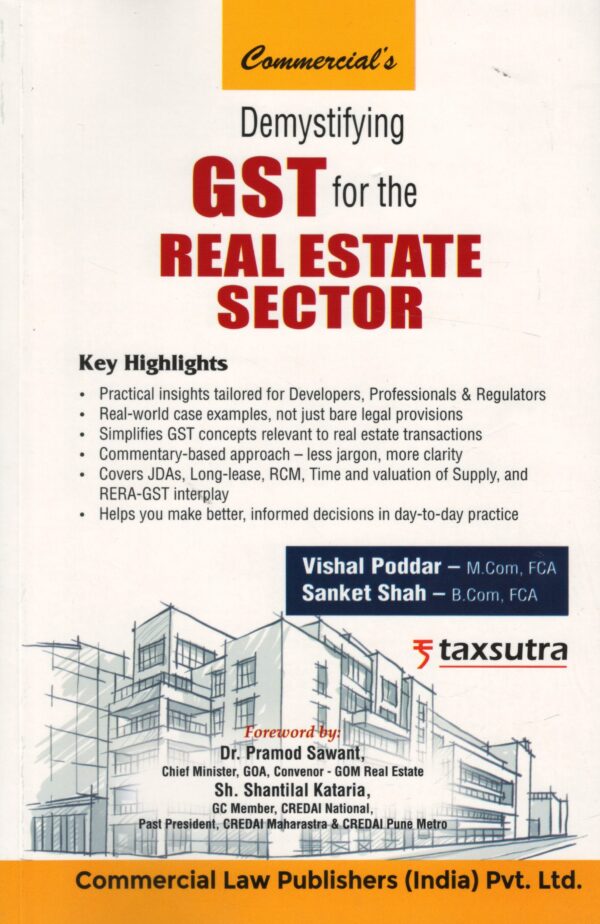
Commercial Demystifying GST for the Real Eastate Sector by Vishal Poddar & Sanket Shah Edition 2025
Demystifying GST for Real Estate offers a practical, authoritative overview of GST’s impact on India’s property sector. Updated in 2025, it covers:
-
Rate structures and ITC mechanisms
-
Developer and buyer implications
-
Compliance strategies and pitfalls
-
Interpretation of development rights and JDAs
-
Recent legislative amendments and future-forward reforms
This makes it indispensable for developers, tax professionals, realtors, investors, and legal advisors aiming to navigate—or benefit from—GST in real estate.

Description
🏗️ 1. Simplified & Unified Tax Structure
-
GST consolidated multiple taxes (VAT, service tax, stamp duty is still outside) into a single levy for under‑construction properties—making the system clearer but adding some complexities
-
Land and ready‑to‑move‑in properties remain outside GST’s purview, creating unique treatment and valuation scenarios
📉 2. Tiered GST Rates Based on Project Type
| Property Type | GST Rate | ITC Availability |
|---|---|---|
| Under‑construction (standard) | 12 % on 2/3rd of value (effective 12 %) | ✅ Yes |
| Affordable housing / CLSS projects | 8 % or reduced to 1 % (no ITC) | ❌ No |
| Ready‑to‑move / Resale / Land | N/A | ❌ No |
💡 3. Input Tax Credit (ITC) & Anti‑Profit Measures
-
Developers can claim ITC on inputs, potentially lowering costs—provided they pass it on to buyers
-
Anti‑profiteering rules ensure developers don’t pocket ITC savings without adjusting prices
⚠️ 4. Compliance & Operational Challenges
-
Multiple state registrations, credit reversals, abatement calculations, and RCM on unregistered supplier purchases lead to administrative and compliance burdens
-
Ambiguities persist around GST applicability on JDAs, development rights (TDR/FSI), and valuation timing—leading to inconsistent practices and litigation .
🏘️ 5. Impact on Buyers & Developers
-
Buyers: Face higher upfront costs (12% for standard under‑construction), though affordable segments benefit from lower slabs (1–8%). Stamp duty and registration charges still apply separately mymagnet.io.
-
Developers: Gain from ITC but must navigate complex compliance. Composition scheme without ITC can lead to tax cascading on inputs such as cement and steel
📉 6. Post‑2019 Rate Rationalisation
-
GST on under‑construction homes reduced from 12 % to 5 % (non‑affordable) and to 1 % (affordable, without ITC) from April 1, 2019—boosting demand but raising concerns over loss of input credits mumbaimirror.indiatimes.com.
🔮 7. Ongoing Reforms & Future Outlook
-
Push for full integration of stamp duty into GST to create a truly unified tax system reddit.com+6mondaq.com+6economictimes.indiatimes.com+6.
-
Calls to liberalize ITC restrictions and provide clarity on valuation of development rights and JDA accounting
Additional information
| Weight | 0.500 kg |
|---|---|
| Authors | |
| Binding | |
| Edition | |
| ISBN | |
| Language | |
| Publisher |