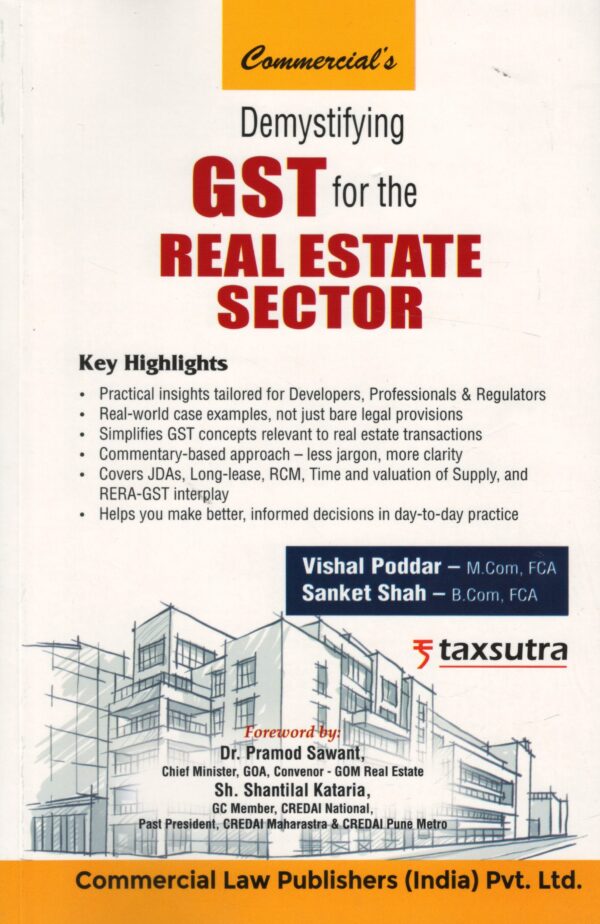
Commercial Demystifying GST for the Real Eastate Sector by Vishal Poddar & Sanket Shah Edition 2025
Demystifying GST for Real Estate offers a practical, authoritative overview of GST’s impact on India’s property sector. Updated in 2025, it covers:
Rate structures and ITC mechanisms
Developer and buyer implications
Compliance strategies and pitfalls
Interpretation of development rights and JDAs
Recent legislative amendments and future-forward reforms
This makes it indispensable for developers, tax professionals, realtors, investors, and legal advisors aiming to navigate—or benefit from—GST in real estate.

Description
🏗️ 1. Simplified & Unified Tax Structure
GST consolidated multiple taxes (VAT, service tax, stamp duty is still outside) into a single levy for under‑construction properties—making the system clearer but adding some complexities
Land and ready‑to‑move‑in properties remain outside GST’s purview, creating unique treatment and valuation scenarios
📉 2. Tiered GST Rates Based on Project Type
| Property Type | GST Rate | ITC Availability |
|---|---|---|
| Under‑construction (standard) | 12 % on 2/3rd of value (effective 12 %) | ✅ Yes |
| Affordable housing / CLSS projects | 8 % or reduced to 1 % (no ITC) | ❌ No |
| Ready‑to‑move / Resale / Land | N/A | ❌ No |
💡 3. Input Tax Credit (ITC) & Anti‑Profit Measures
Developers can claim ITC on inputs, potentially lowering costs—provided they pass it on to buyers
Anti‑profiteering rules ensure developers don’t pocket ITC savings without adjusting prices
⚠️ 4. Compliance & Operational Challenges
Multiple state registrations, credit reversals, abatement calculations, and RCM on unregistered supplier purchases lead to administrative and compliance burdens
Ambiguities persist around GST applicability on JDAs, development rights (TDR/FSI), and valuation timing—leading to inconsistent practices and litigation .
🏘️ 5. Impact on Buyers & Developers
Buyers: Face higher upfront costs (12% for standard under‑construction), though affordable segments benefit from lower slabs (1–8%). Stamp duty and registration charges still apply separately mymagnet.io.
Developers: Gain from ITC but must navigate complex compliance. Composition scheme without ITC can lead to tax cascading on inputs such as cement and steel
📉 6. Post‑2019 Rate Rationalisation
GST on under‑construction homes reduced from 12 % to 5 % (non‑affordable) and to 1 % (affordable, without ITC) from April 1, 2019—boosting demand but raising concerns over loss of input credits mumbaimirror.indiatimes.com.
🔮 7. Ongoing Reforms & Future Outlook
Push for full integration of stamp duty into GST to create a truly unified tax system reddit.com+6mondaq.com+6economictimes.indiatimes.com+6.
Calls to liberalize ITC restrictions and provide clarity on valuation of development rights and JDA accounting
Additional information
| Weight | 0.500 kg |
|---|---|
| Authors | |
| Binding | |
| Edition | |
| ISBN | |
| Language | |
| Publisher |