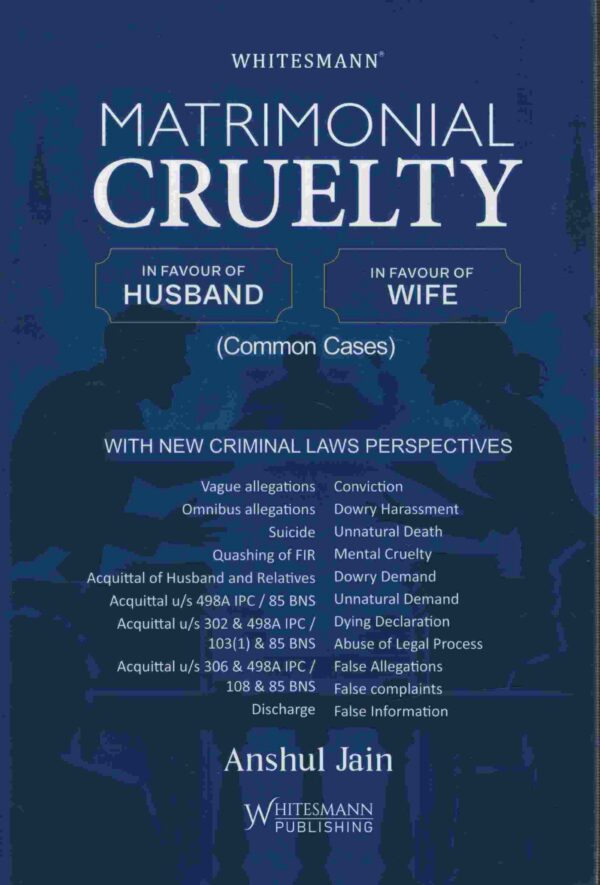
Whitesmann’s Matrimonial Cruelty – In Favour of Husband / In Favour of Wife (Common Cases) By Anshul Jain Edition 2027
Whitesmann’s Matrimonial Cruelty – In Favour of Husband / In Favour of Wife (Common Cases) By Anshul Jain Edition 2027
A case-law digest on matrimonial cruelty arranged by outcome, separating the authorities decided in favour of the husband from those decided in favour of the wife, and covering the fact patterns that recur in practice. The husband’s side covers vague and omnibus allegations, quashing of FIR, discharge, acquittal of the husband and his relatives, acquittal under Section 498A IPC and Section 85 BNS, acquittal under Sections 302 and 498A IPC and Sections 103(1) and 85 BNS, acquittal under Sections 306 and 498A IPC and Sections 108 and 85 BNS, suicide and abetment, false allegations, false complaints and false information, and abuse of the legal process. The wife’s side covers conviction, dowry harassment and dowry demand, unnatural demand, mental cruelty, unnatural death and the presumptions arising within seven years of marriage, and the evidentiary value of a dying declaration. Written with New Criminal Laws Perspectives, giving the authorities under both the Indian Penal Code and the corresponding provisions of the Bharatiya Nyaya Sanhita, 2023. Hardbound, Whitesmann Publishing.

Description
Whitesmann’s Matrimonial Cruelty – In Favour of Husband / In Favour of Wife (Common Cases) By Anshul Jain Edition 2027
Matrimonial Cruelty — In Favour of Husband / In Favour of Wife (Common Cases) by Anshul Jain, published by Whitesmann Publishing, is a case-law digest on matrimonial cruelty built around a single, unusual organising idea: it sorts the authorities by which side they help. With New Criminal Laws Perspectives.
Anyone who has run a Section 498A matter knows why that matters. The reported law on matrimonial cruelty is vast and pulls in both directions — there are judgments on omnibus allegations against every member of a husband’s family, and there are judgments on the reality of dowry harassment and the weight of a dying declaration. A practitioner does not need a neutral survey; they need the line of authority that supports the case they are actually arguing, found quickly. This book is arranged to deliver exactly that.
It is also written for the transition to the new criminal laws. Cruelty by a husband or his relatives was Section 498A of the Indian Penal Code and is now Section 85 of the Bharatiya Nyaya Sanhita, 2023; murder under Section 302 IPC is now Section 103(1) BNS; abetment of suicide under Section 306 IPC is now Section 108 BNS. The book gives the authorities under both numbering systems — which is necessary, because the decided cases are under the IPC and the charge sheets now coming in are under the BNS.
Key Features
- Organised by outcome — separate treatment of cases decided in favour of the husband and in favour of the wife, so the relevant line of authority is found immediately.
- Common cases — the fact patterns that actually recur, rather than a comprehensive but undifferentiated digest.
- With New Criminal Laws Perspectives — authorities given under both the IPC and the corresponding BNS provisions.
- Section 498A IPC / Section 85 BNS treated throughout as the central provision.
- Covers the full procedural arc — quashing of FIR, discharge, acquittal and conviction.
- Hardbound, from Whitesmann Publishing.
- Newly released, so the case law is current.
Coverage
Cases in favour of the husband
- Vague allegations — where the complaint discloses no specific act, date or incident.
- Omnibus allegations — the roping in of parents, siblings and distant relatives without particulars, and the courts’ response.
- Quashing of FIR — the grounds on which a High Court will exercise its inherent power in a matrimonial case.
- Discharge — the test at the charge stage, and when the material does not make out a prima facie case.
- Acquittal of the husband and his relatives.
- Acquittal under Section 498A IPC / Section 85 BNS.
- Acquittal under Sections 302 and 498A IPC / Sections 103(1) and 85 BNS — where a dowry death or murder charge accompanies the cruelty charge.
- Acquittal under Sections 306 and 498A IPC / Sections 108 and 85 BNS — abetment of suicide with cruelty.
- Suicide — the proximity requirement and the evidence needed to establish abetment.
- False allegations, false complaints and false information, and the consequences of them.
- Abuse of the legal process, and the courts’ treatment of matrimonial litigation brought for collateral ends.
Cases in favour of the wife
- Conviction under the cruelty provisions, and what sustains it on appeal.
- Dowry harassment and dowry demand — proof, the pattern of demands, and corroboration.
- Unnatural demand and the forms harassment takes beyond money.
- Mental cruelty — its recognition, and the conduct that constitutes it.
- Unnatural death — the presumptions that arise where a woman dies otherwise than in normal circumstances within seven years of marriage.
- Dying declaration — its evidentiary value in matrimonial death cases, and when it can be acted on without corroboration.
Who Should Buy This Book?
- Criminal and matrimonial advocates — on either side of a Section 498A / Section 85 BNS matter.
- Defence counsel seeking quashing, discharge or acquittal for a husband and his family.
- Counsel for complainants, and for women’s legal aid organisations.
- Public Prosecutors conducting cruelty and dowry death trials.
- Judges, judicial officers and Magistrates hearing matrimonial criminal matters.
- Family court practitioners, where the criminal and matrimonial proceedings run in parallel.
- Police officers and investigating officers registering and investigating complaints under the new provisions.
- Judicial service aspirants and LL.M. students working on family and criminal law.
- Court and bar association libraries.
Why Choose This Book?
The organising principle is what makes this book worth owning. Most digests on cruelty arrange the material by section or by topic, which means a practitioner looking for support must read through authorities going both ways and extract the useful ones. Sorting by outcome — in favour of the husband, in favour of the wife — is frankly partisan as an index, and that is precisely its utility at the moment counsel is preparing an argument. It is a book built for the way the work is actually done.
The second reason is the new criminal laws. Section 498A has been renumbered as Section 85 of the Bharatiya Nyaya Sanhita, and the related charges under Sections 302 and 306 IPC are now Sections 103(1) and 108 BNS. Every reported authority is under the old numbering; every fresh case is under the new. A digest that carries both, as this one does on its face, removes a conversion step from every single citation — and in a field where the governing law is almost entirely judge-made, that is not a small saving.
Additional information
| Weight | 1.2 kg |
|---|---|
| Authors | |
| Binding | |
| Edition | |
| ISBN | |
| Language | |
| Publisher |