
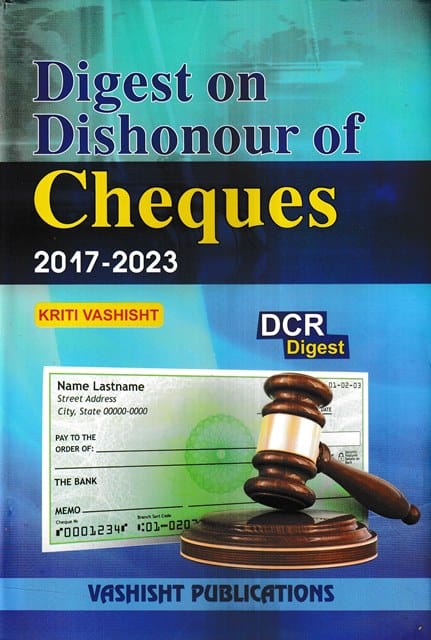
Vashisht Publication Digest on Dishonour of Cheques 2017-2023 by Kriti Vashisht Edition 2023
Vashisht Publication Digest on Dishonour of Cheques 2017-2023 by Kriti Vashisht Edition 2023

Description
Vashisht Publication Digest on Dishonour of Cheques 2017-2023 by Kriti Vashisht Edition 2023
Vashisht Publication Digest on Dishonour of Cheques 2017-2023 by Kriti Vashisht Edition 2023
If a cheque, issued by a drawer pursuant to the discharge of a liability to the payee, is returned by the drawee bank due to the drawer not having sufficient credit/funds in his bank account, the drawer is deemed to have committed the offence of dishonouring a cheque. This imposition of criminal liability, as per Section 138 of the Act, on a person issuing bad cheques is not an age-old concept. In fact, prior to the introduction of the Banking, Public Financial Institutions and Negotiable Instruments Laws (Amendment) Act, 1988, the only remedy available to the payee of a dishonoured cheque lay in civil law. It is only after 1988 that the law of the land, seeking “to enhance the acceptability of cheques in settlement of liabilities.…”[2], brought drawers of bounced cheques under the purview of criminal law, while leaving the jurisdiction of civil courts, to also give remedy to the payees of such cheques, unaffected. Though an act is usually criminalised for the purpose of punishing the offender, rather than compensating the victim; in the case of cheque dishonouring, practical experience and the scheme of the Act shows us that the compensatory aspect of the crime takes precedence over the punitive. This predominantly compensatory object of the provisions of Chapter 17 of the Act is evidenced by the fine imposable by the court being linked to the cheque amount[3], the compoundability of the offence[4], cognizance of the offence only being taken on written complaint by the payee[5], and the summary trial procedure applicable to Section 138 proceedings[6]. The scheme of the law governing the offence of cheque dishonour seems to encourage the parties to settle the dispute by having the offender pay the cheque amount and avoid penal confinement. The Supreme Court has even devised a scheme for the graded increase in fines levied to encourage early compounding of the offence[7]. Even if the accused refuses to compromise, the Court can impose a fine up to double the cheque amount and apply it to compensate the payees of the bad cheque[8]. This primary objective of giving compensatory relief to the payee of the cheque is essentially civil in nature. Section 138 of the Act, thus, seeks to provide a civil remedy through the criminal justice apparatus. The Supreme Court has on several instances recognised that cheque dishonour cases “are really civil cases masquerading as criminal cases”.[9] The pre-eminent role of compensatory, rather than punitive considerations, while disposing of cases of cheque dishonour is evident from the Supreme Court’s decision in Meters and Instruments (P) Ltd. v. Kanchan Mehta[10], wherein the Court allowed the discharging of the accused even if the cases were not compounded with the consent of both parties; so long as the criminal court found that the complainant was duly compensated[11]. In fact, the question of decriminalising cheque dishonouring was first hinted at by the Supreme Court in an order passed by it in March of 2020.[12] When we look at the basic end that the law relating to cheque dishonour aims to serve, as well as the operation of the law in practice, it is clear that the decriminalisation of the offence would not drastically alter the substantive rights of the payee of a dishonoured cheque. Under present law, upon dishonour of a cheque, the payee of the cheque can approach both civil and criminal fora. The payee can move civil courts by means of a suit for recovery linked to the liability sought to be discharged by the cheque. He or she can also approach criminal courts writing a complaint to a Magistrate of an offence under Section 138 of the Act. Though the liberty accorded to the payee of a dishonoured cheque to move multiple fora for remedy would, prima facie, appear to best serve the ends of justice, it does pose some problems, namely—…
https://www.scconline.com/blog/post/2021/02/16/cheque-dishonour/
Additional information
| Weight | 2 kg |
|---|---|
| ISBN | |
| Binding | |
| Edition | |
| Language | |
| Publisher |

Rating & Review
There are no reviews yet.