
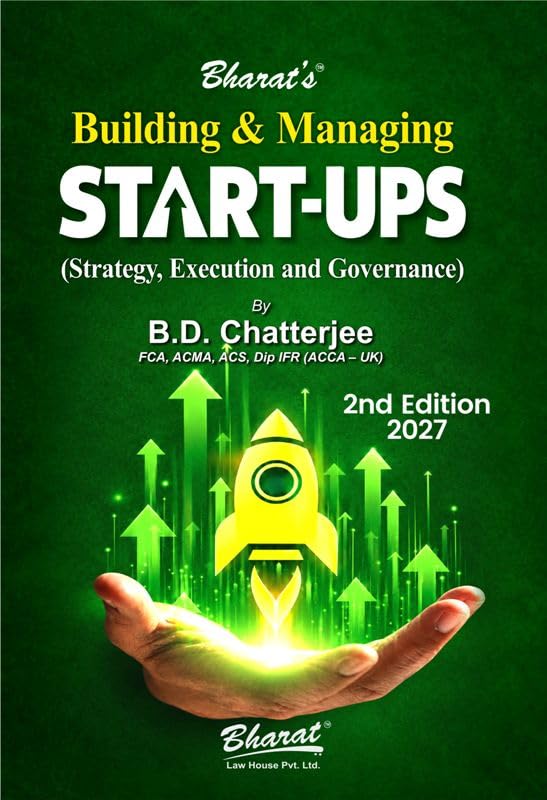
Bharat’s Building & Managing START-UPS (Strategy, Execution and Governance) By B.D. Chatterjee 2nd Edition 2027
Bharat’s Building & Managing START-UPS (Strategy, Execution and Governance) (2nd Edition, 2027) by B.D. Chatterjee is published by Bharat Law House Pvt. Ltd. and focuses on bootstrapped entrepreneurship and building profitable businesses in India

Description
Bharat’s Building & Managing START-UPS (Strategy, Execution and Governance) By
A start-up begins with an idea, but becomes an enterprise only when that idea is translated into a viable business model, a capable organisation and a disciplined system of execution. The journey runs from customer validation, legal formation, strategy and funding, through people, processes, technology, risk, compliance and governance, to valuation, investor rights and exit.
Founders often meet these issues separately, yet must bring them together. A decision that looks attractive from one standpoint can backfire elsewhere: rapid growth can consume cash, funding can dilute control, technology can add cyber risk, and a high headline exit value may not translate into equivalent shareholder proceeds.This book, Building & Managing Start-ups (Strategy, Execution & Governance) Second Edition, offers an integrated and practical guide to that journey.
Scope and Structure
The twenty chapters follow this progression. The early chapters cover opportunity identification, market validation, business models, legal formation, strategy, and business and financial planning. The next group addresses funding, capital structure, founder ownership, ESOPs, organisation, people, processes and execution, with attention to the trade-offs between growth and cash, ownership and external capital, and speed and control.The book then examines enterprise systems, cybersecurity, risk management, internal controls, compliance, government support and governance: foundations that belong early, as proportionate disciplines rather than bureaucracy.
The later chapters cover performance measurement, scaling, valuation, subsequent rounds, investor relationships, dilution and exit, showing that valuation cannot be separated from risk, growth from unit economics, or exit value from the rights attached to different securities. The final chapter integrates these disciplines through ten case studies across sectors, from consumer products and SaaS to deep technology, agritech and energy.
Detailed Contents
Chapter 1 From Idea to Sustainable Enterprise
Chapter 2 Artificial Intelligence for Entrepreneurs: Building and Managing the AI-Enabled Start-up
Chapter 3 From Idea to Opportunity: Incubating Successful Start-ups
Chapter 4 Choosing the Right Legal Structure and Incorporating Your Start-up
Chapter 5 Building a Winning Business Strategy
Chapter 6 Developing an Investor-Ready Business Plan
Chapter 7 Step-by-Step Guide to Developing an Integrated Financial Plan
Chapter 8 Funding Strategy and Capital Raising
Chapter 9 Building and Managing the Start-up Team
Chapter 10 Building Business Processes and Operating Systems
Chapter 11 Technology Enterprise Systems, Digital Infrastructure and
Chapter 12 Risk Management and Internal Controls
Chapter 13 Legal, Regulatory and Compliance Management
Chapter 14 Governance and Board Effectiveness
Chapter 15 Government Schemes and Start-Up Ecosystem Support
Chapter 16 Government Schemes and Start-Up Ecosystem Support
Chapter 17 Managing Growth and Scaling the Start-up
Chapter 18 Valuation of Start-ups
Chapter 19 Managing Investors, Subsequent Funding Rounds and Exit
Chapter 20 Integrated Start-up Case Studies
Appendices
Appendix A Start-up Management Master Checklist
Appendix B Glossary of Start-up, Finance and Investor Terms
Appendix C AI Application Checklist – From Idea to Exit
Appendix D Indian Regulatory and Scheme Quick Reference.
Additional information
| Weight | 2.1 kg |
|---|---|
| Authors | |
| Edition | |
| Binding | |
| Publisher | |
| ISBN | |
| Language |